
Microbiological quality · OEM buyer guide
Do peptide microneedle patches need to be sterile?
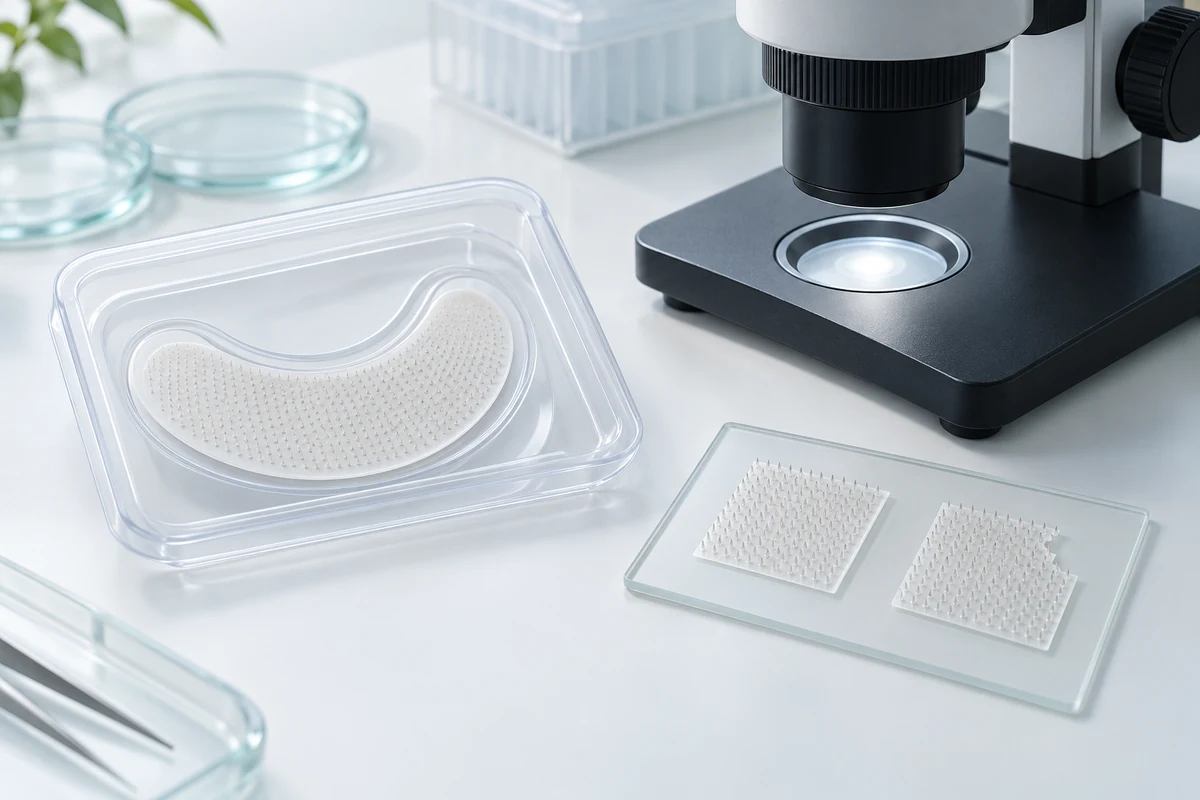
For a product legally classified as a cosmetic, the U.S. FDA says sterility is not generally required. That does not settle the status of a peptide microneedle patch. Needle design, intended skin interaction and product claims can change its regulatory pathway. An OEM brief should first establish classification, then specify the microbial quality evidence needed for the finished, packaged product.
Classify the proposed patch before using the word “sterile”
The FDA’s cosmetic testing guidance says cosmetics need not be sterile, while harmful microorganisms must be absent and aerobic counts kept low. Its separate microneedling guidance explains when a microneedling product is a medical device. A peptide-loaded patch therefore needs a product-specific assessment of its needle geometry, intended use, mechanism and claims. A cosmetic label or a short needle claim cannot substitute for that review. Requirements outside the United States must be evaluated for each destination market. The site’s cosmetic, device and drug classification guide sets out the questions to resolve before an OEM quotation becomes a launch plan.
Ask what the finished-product microbiology result represents
A raw peptide certificate of analysis describes one ingredient lot. It cannot show the microbial status of the cast array after matrix preparation, drying, handling and sealing. ISO 17516:2014 addresses microbiological limits for cosmetics; the FDA’s BAM Chapter 23 is a method reference for examining cosmetics. Neither is a ready-made release specification for every microneedle design. Ask the manufacturer and laboratory to state how the selected method works with the actual dissolving matrix and how the sample relates to the commercial pack.
- Product and lot identity, including the sampled unit: array, patch, pouch or kit.
- The intended microbial attributes and acceptance criteria for the classified product.
- Method suitability for the peptide-polymer matrix and any relevant packaging component.
- Sampling frequency, release decision, retained-sample plan and deviation handling.
- Laboratory report, batch record and traceability back to incoming materials.
The raw-material qualification guide covers incoming records; the finished-patch question must still be answered separately.
Dry and individually pouched does not automatically mean low risk
A low-moisture array in a sealed pouch may limit conditions favorable to microbial growth, but that observation alone is not a documented risk assessment. ISO 29621:2017 provides a framework for identifying microbiologically low-risk cosmetic products based on production and intended use. The reviewer needs evidence about initial material quality, residual moisture or water activity, handling before sealing, package integrity and foreseeable use. If the final design includes a wet companion product, reusable applicator or a changed pouch, revisit the assessment. Our guides on residual moisture and barrier packaging address two inputs to that decision; neither proves microbiological safety by itself.
When does a preservation-efficacy study belong in the plan?
ISO 11930:2019, with its 2022 amendment, covers evaluation of antimicrobial protection in cosmetics. Its preservation-efficacy test is primarily designed for water-soluble or water-miscible formulations. The standard also recognizes a low-risk route based on ISO 29621. A dry single-use array and a water-based companion serum should not be assigned the same test plan by habit. Record why a preservation study applies, needs adaptation, or is not appropriate for each component and its intended use.
Keep a sterility claim separate from routine microbial control
“Low microbial count,” “manufactured in a clean environment” and “sterile” are different statements. A foil pouch is a barrier package, not evidence that its contents were sterilized. If a buyer proposes a sterile product or a sterilization step, request evidence that the complete process and package maintain the claimed status and that the process does not compromise peptide identity, array geometry or dissolution. The specification and labeling should reflect the classified product and evidence actually held. Do not add a sterile symbol to a mockup before this work is complete.
Put these details in the OEM request
- Destination markets, intended users, application site and proposed claims.
- Array design and intended skin interaction, plus whether any applicator is reused.
- Peptide, matrix, companion product and complete single-use pack configuration.
- Proposed microbiological quality criteria and the reason for each test or exemption.
- Finished-product sampling, laboratory method, batch records and change-control owner.
- Any proposed sterility claim, with a separate evidence and regulatory review plan.
The site’s safety-substantiation guide covers skin compatibility and other evidence outside microbiology.
FAQ
Does a sealed foil pouch make the patch sterile?
No. The pouch protects the product according to its tested barrier and seal properties. It does not establish that a sterilization process occurred or that sterility was maintained.
Can a clean raw-material COA replace finished-patch testing?
No. It concerns the incoming material, not contamination that could occur during manufacture or packaging. Decide the finished-product controls through a documented risk assessment and applicable product requirements.
Is an ISO 11930 challenge test mandatory for every dry patch?
No. ISO 11930 describes preservation-efficacy evaluation and a risk-based route for products considered microbiologically low risk. The finished formulation, packaging and use pattern determine the appropriate study plan.
Does the FDA’s cosmetic sterility statement cover every microneedle patch?
No. It applies to products classified as cosmetics. Microneedle design, penetration, intended use and claims need separate classification review before cosmetic guidance is used as the basis for a patch specification.
Primary references
- U.S. FDA, Product Testing of Cosmetics.
- U.S. FDA, Regulatory Considerations for Microneedling Products.
- ISO 17516:2014, Cosmetics: Microbiological limits.
- ISO 29621:2017, Identification of microbiologically low-risk products.
- ISO 11930:2019, Evaluation of antimicrobial protection.
- U.S. FDA, BAM Chapter 23: Methods for Cosmetics.
Send the proposed patch design and target market through the OEM project inquiry so the microbiological brief can be scoped to the actual product.
Turn the research into a manufacturable brief
Share your target market, peptide concept, patch geometry, packaging direction and estimated quantity. We will map the project to sampling, pilot and scale-up stages.