
Commercial solution design
Custom Peptide Microneedle Patch Development
Different channels need different specifications, pack formats, documentation and launch economics. Start with the business model, then engineer the product brief.
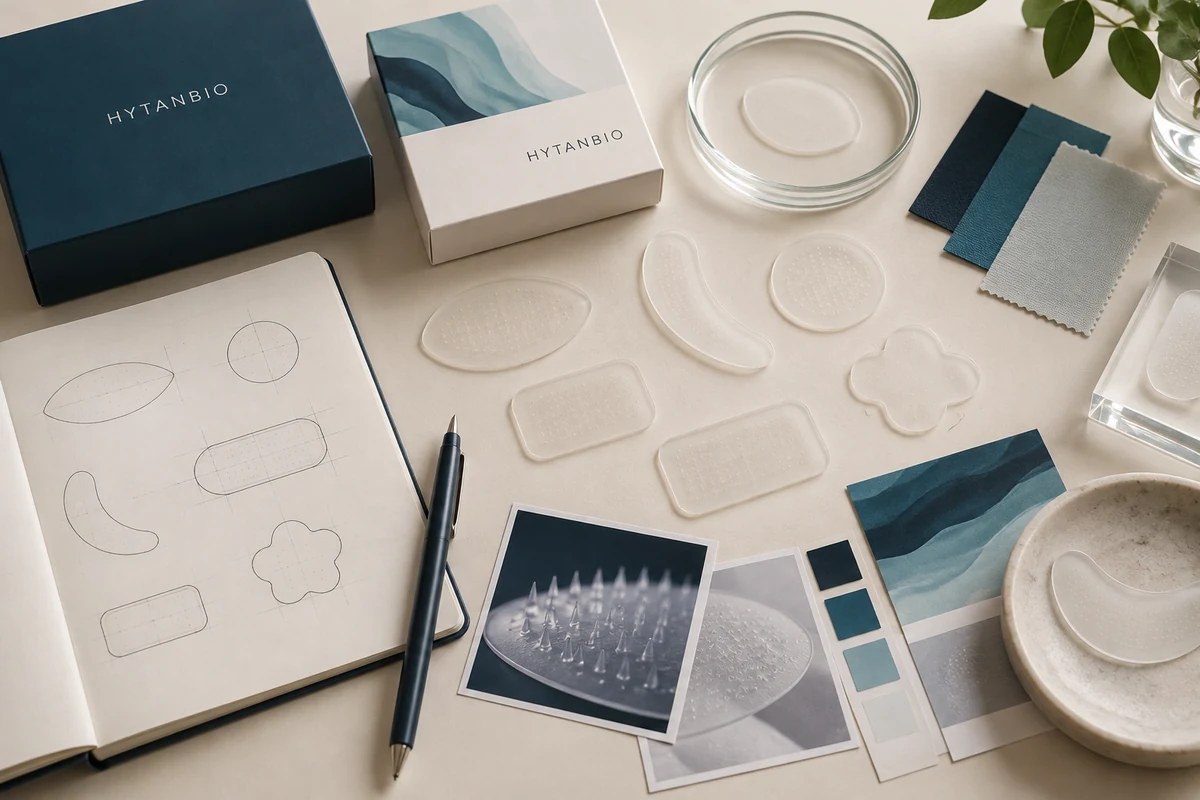
Amazon & marketplace
Compact packaging, clear differentiation, robust handling and a specification designed for repeatable replenishment.
DTC skincare brand
Exclusive peptide story, premium visual identity, education-led content and a coordinated sampling path.
Clinic & spa
Professional presentation, treatment-adjacent cosmetic positioning and pack formats suitable for controlled service environments.
Established cosmetic brand
Formal qualification, artwork control, documentation requirements and scale planning integrated earlier in development.
Exclusive peptide blend
Screen candidate combinations for compatibility, processing fit and market positioning before fixing the commercial specification.
Custom geometry
Patch outline, array, dimensions and needle height aligned to application area, user experience and manufacturing feasibility.
HYTANBIO · Changzhou base
Configure the array, shape and formulation
A complete customization brief defines the geometry, shape, formulation, backing and pack together. The portfolio lists nominal-height bands of 100–500 µm for eye, sensitive-skin and acne-format concepts, 600–800 µm for professional anti-wrinkle and repair concepts, and 800–1,000 µm for body-care concepts. Needle spacing is listed as 500–1,000 µm. These are configuration groupings from the portfolio, not prescribed settings or measured penetration depths. Standard shapes include round, rounded square, crescent eye and T-shaped nasal formats. Custom tooling can create nasolabial strips, contour shapes, larger body formats and specialty designs. Formulation work begins with active selection and loading, then carrier compatibility, optimization, trials and production support. Water-soluble small molecules can be evaluated within dissolving matrices; peptide and other ingredient compatibility still needs project-specific confirmation. Patch size, color and final loading are agreed against the intended application and evidence plan.
- Nominal-height options: 100–500 µm / 600–800 µm / 800–1,000 µm, according to the project.
- Spacing reference: 500–1,000 µm.
- Standard shapes: round, rounded square, crescent eye and T-shaped nasal.
- Custom tooling: nasolabial, contour, larger body and specialty shapes.
- Formulation: active selection and loading → carrier compatibility → optimization → trial samples → production support.
- Physical options: size, color, loading, backing and tray configuration.


Portfolio specifications updated October 15, 2026 · HYTANBIO product portfolio, pages 5. Final configuration and evidence requirements are agreed per project.
Direct answer for buyers
How is peptide microneedle patch feasibility evaluated before scale-up?
Feasibility is evaluated as one connected system: peptide properties, target loading, polymer matrix, pH, mixing and drying exposure, needle geometry, residual moisture, dissolution behavior, backing and moisture-barrier packaging. A responsible program first defines the intended cosmetic or research use and the evidence needed. It then screens compatibility, makes small feasibility arrays, checks visual and mechanical integrity, confirms relevant analytical methods and only advances when acceptance criteria are clear. A successful laboratory sample is not automatically a commercial process; repeatability, pilot scale, packaging and stability still need review. This staged approach identifies failure early and avoids promising that every peptide, dose or claim can be supported in the same platform. A useful next step is a written, non-confidential brief that records the target, assumptions, open questions, proposed evidence and decision criteria before any commercial commitment.
Key parameters
- Peptide data: identity, purity, molecular weight, solubility, pH and temperature sensitivity.
- Matrix data: polymer type, solids, plasticizer, moisture target and compatibility.
- Geometry: needle height, base, density, array area and loading zone.
- Testing: appearance, array integrity, content, uniformity, dissolution and stability.
- Scale path: feasibility sample, repeated lab batch, pilot batch and controlled transfer.
Questions buyers ask
Can heat-sensitive peptides be evaluated?
Yes, but actual protection depends on process time, moisture, oxygen, matrix chemistry and analytical confirmation.
Is a custom mold always required?
No. Existing arrays may suit early samples; a custom mold is justified when geometry, shape, loading or differentiation requires it.
What makes a sample ready for pilot work?
Defined specifications, repeatable batches, agreed test methods, packaging assumptions and acceptable stability signals are needed.
Can development guarantee market approval?
No. Technical development supports evidence generation; final classification and authorization are market-specific.