
Packaging engineering · OEM buyer guide
How to qualify moisture-barrier packaging for peptide microneedle patches
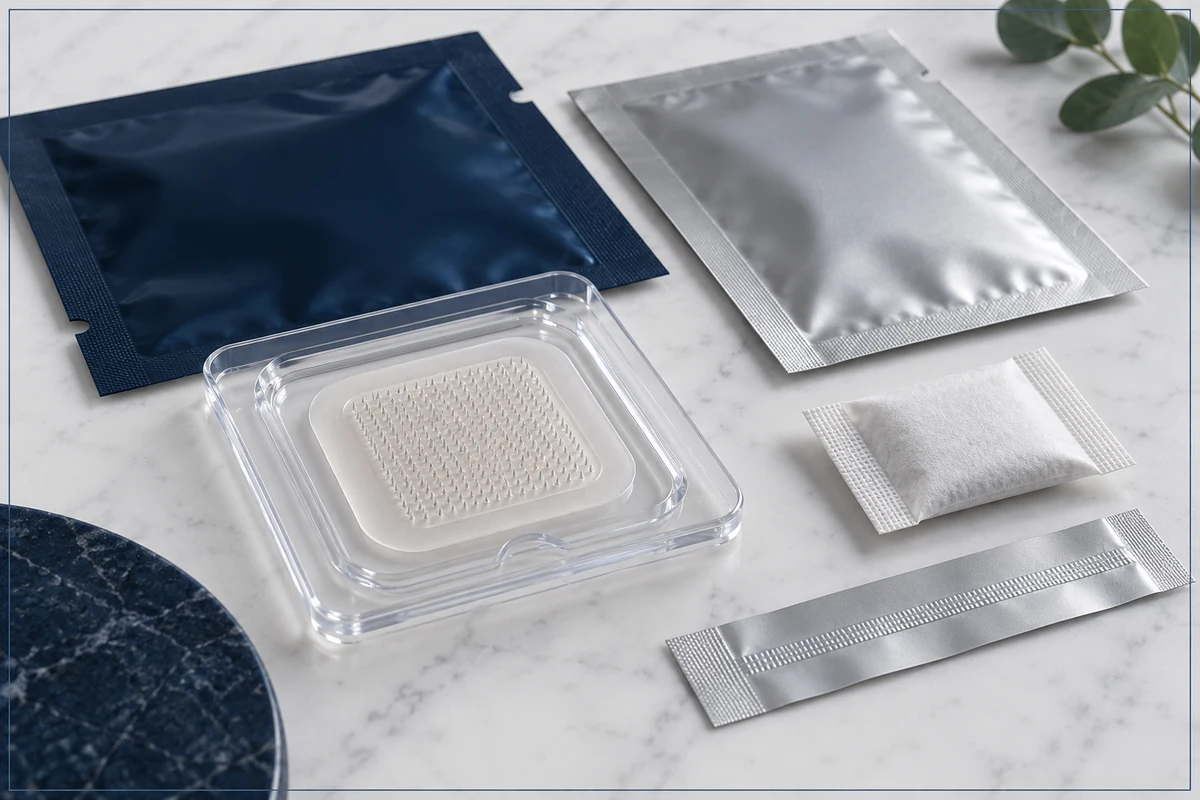
A foil-looking pouch is not a moisture specification. For a dissolving peptide microneedle patch, compare the film’s water-vapor transmission rate, the finished pouch seal and the patch’s condition after storage. A desiccant may help only when its capacity and position are compatible with the sealed pack.
Define the moisture problem before choosing a pouch
Hyaluronic acid and other water-sensitive matrices can change as they take up moisture. The consequence might appear as altered tip shape, handling behavior, dissolution or peptide stability; the important failure mode depends on the formula. Establish a baseline from the actual patch rather than choosing packaging by appearance. Record the initial moisture measure, the proposed storage environment and which product attribute changes first. See our residual moisture and water activity guide for the difference between those two measures.
- Matrix and peptide combination under evaluation.
- Patch mass and needle geometry that must be preserved.
- Maximum acceptable change in the agreed attributes.
- Proposed sale, storage and distribution conditions.
Read a film WVTR value in context
Water-vapor transmission rate, or WVTR, describes transfer through a material under specified test conditions. ASTM F1249-25 is a test method for measuring WVTR of flexible barrier materials. Compare values only when the test temperature, humidity gradient, units and specimen construction are stated. A film result is not a finished-pouch result: cut edges, folds, heat seals and handling damage add possible entry paths.
Five fields to request in a barrier-film data sheet
- Actual laminate construction, including any foil or coating layer.
- WVTR value, unit and test method.
- Temperature and relative-humidity conditions of the test.
- Thickness and whether the sample was flat film or a converted pack.
- Change-control notice if any layer, supplier or sealant changes.
Test the sealed configuration that will be sold
The final pack may include a cavity tray, a paper insert and a desiccant. Each affects fit and sealing clearance. Specify where a desiccant sits so it cannot damage tips or be mistaken for the product. Ask for seal-width and appearance checks, a suitable seal-strength or integrity method, and stability samples in the intended pouch. The site’s seal-integrity guide explains why an intact-looking seam alone does not establish a complete barrier.
Packaging decisions also affect recyclability and pack volume. Those tradeoffs can be evaluated after the minimum protective performance has been demonstrated. A material-level WVTR number cannot establish a shelf-life period or environmental claim for the finished product.
FAQ
Does adding a desiccant guarantee a dry patch?
No. The sealed pouch still needs a suitable barrier and seal. Desiccant capacity, initial product moisture and expected exposure all affect the result.
Can two suppliers’ WVTR values be compared directly?
Only after checking the method, unit, temperature, humidity difference and film construction. Different conditions can produce numbers that are not comparable.
Is the pouch film test enough to set shelf life?
No. Confirm the converted pouch and finished patch together under a justified stability plan. The release and end-of-life limits should refer to the actual product attributes.
References
- ASTM F1249-25, Water Vapor Transmission Rate Through Plastic Film and Sheeting.
- ISO 22716:2007, Cosmetics Good Manufacturing Practices.
Send the proposed pouch construction and target markets through our OEM inquiry form so the package can be evaluated with the selected patch rather than as an isolated film sample.
Turn the research into a manufacturable brief
Share your target market, peptide concept, patch geometry, packaging direction and estimated quantity. We will map the project to sampling, pilot and scale-up stages.