
Peptide microneedle patch technical guide
From Peptide Supplier List to Cosmetic Microneedle Patch: A Screening Guide
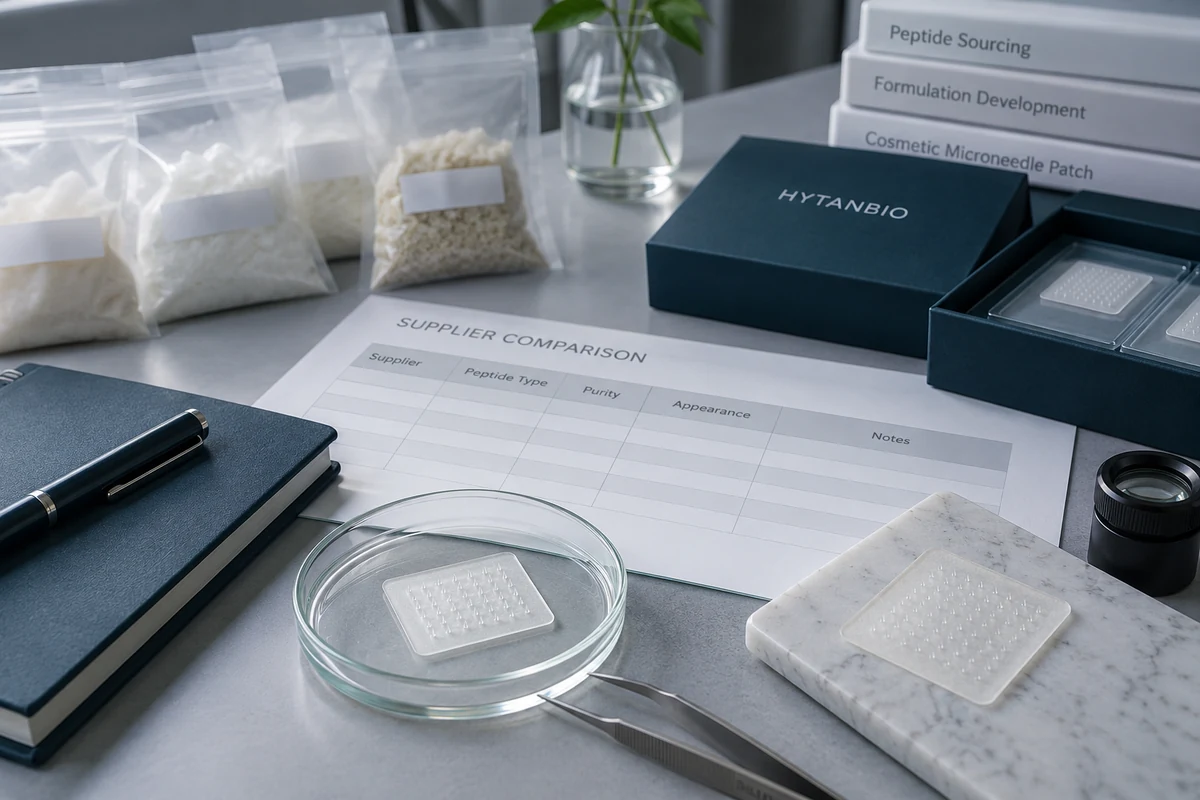
Candidates identified for cosmetic concept development
The most relevant entries were GHK-Cu, AHK-Cu, Acetyl Octapeptide-3, a Palmitoyl Pentapeptide-4 type product listed under a trade name, and glutathione. These map to copper-peptide renewal, smoothing, firming, radiance and hairline cosmetic concepts, subject to ingredient identity, purity, market status and finished-product validation.
Materials that can support a patch but are not peptides
Hyaluronic acid appears in the list, but it is a polysaccharide rather than a peptide. It may still be useful as an array-forming or hydration-supporting material depending on molecular weight and matrix design. NAD+, vitamins, carnitine and similar entries also should not be labeled as peptides.
Research peptides that need a separate decision
KPV and several experimental peptides have interesting scientific literature, but that does not automatically establish cosmetic ingredient status, safe concentration, claims or commercial acceptability in every market. Keep these in an R&D review queue until regulatory and safety evidence is complete.
Products excluded from the ordinary cosmetic line
Semaglutide, Tirzepatide, Retatrutide, Liraglutide, Cagrilintide, Insulin, BPC-157, TB-500, CJC, GHRP products, HGH, IGF products, Melanotan, Teriparatide, Oxytocin and Botulinum toxin are medicinal, injectable or research-use products. They should not be converted into a cosmetic SKU simply by changing the delivery format.
A responsible screening workflow
- Classify cosmetic, medicinal, device and research status.
- Confirm exact chemical or INCI identity rather than relying on a trade name.
- Review purity, residuals, source and supplier documentation.
- Assess solubility, pH, oxidation and drying sensitivity.
- Prototype the array and measure strength, geometry and dissolution.
- Validate safety, stability, packaging and claims for the target market.
Frequently asked questions
Can an injectable peptide also be made as a cosmetic patch?
Changing the dosage form does not change the substance’s intended use or regulatory obligations. Medicinal peptides require the applicable drug and device pathway.
Why avoid trade names such as Matrixyl or SNAP-8 on private-label packaging?
Trade names may be protected and can also refer to supplier-specific blends. Use verified INCI or chemical identity unless the relevant trademark and supplier program are authorized.
Turn the research into a manufacturable brief
Share your target market, peptide concept, patch geometry, packaging direction and estimated quantity. We will map the project to sampling, pilot and scale-up stages.