
Peptide microneedle patch technical guide
Acetyl Hexapeptide-8 Microneedle Patch OEM Guide
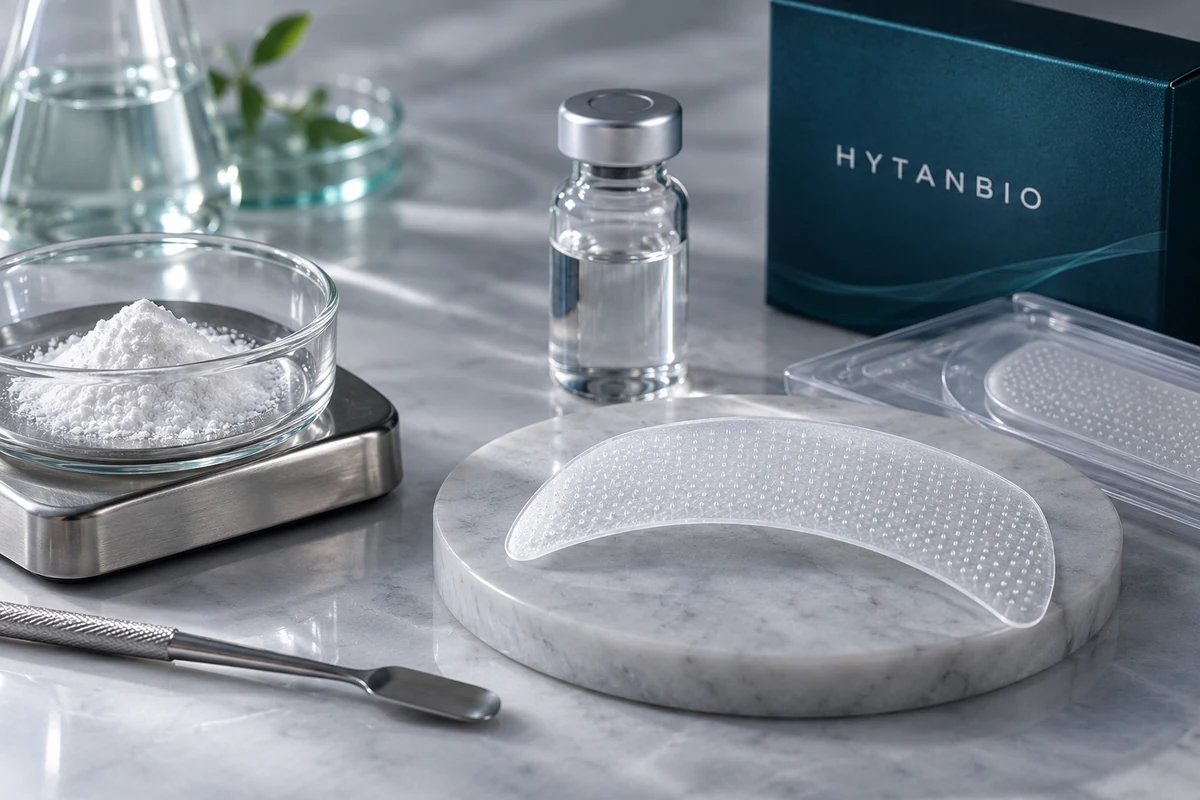
Why brands select Acetyl Hexapeptide-8
It is widely recognized in cosmetic formulation and maps naturally to targeted appearance-of-fine-lines positioning. It can support forehead, crow’s-feet and smile-line product concepts without relying on injectable comparisons.
Key development questions
Confirm the raw-material form, assay, recommended pH range and storage. Determine whether the peptide is distributed throughout the array or concentrated in the tips. Test whether the target loading changes viscosity, mold filling, drying time or needle strength.
Product formats
Commercial directions include forehead strips, under-eye crescents, smile-line pairs and compact oval patches. Packaging can range from one-pair foil sachets to four-week premium kits.
Evidence and claims
Finished-product claims should be based on the actual commercial patch, wear protocol and target population. Ingredient-level literature is useful for formulation rationale but does not replace finished-product substantiation.
Frequently asked questions
Can it be combined with hyaluronic acid?
Often yes as a concept, but polymer grade, molecular weight, solids ratio and mechanical performance must be optimized.
Can it be marketed as a Botox alternative?
That wording creates significant claim risk. Use cosmetic appearance language supported by the finished product and avoid drug or procedure equivalence.
Turn the research into a manufacturable brief
Share your target market, peptide concept, patch geometry, packaging direction and estimated quantity. We will map the project to sampling, pilot and scale-up stages.